
Tire Load SL vs. XL: What to Know Before Buying Your Next Set of Tires
Tire Load Range SL vs. XL: What to Know Before Buying Your Next Set of Tires
Shopping for tires involves more than finding the correct diameter and choosing a tread pattern. The letters and numbers printed on a tire’s sidewall describe important specifications, including its size, load range, load index, speed rating, and construction.
Two designations that frequently cause confusion are SL and XL.
SL stands for Standard Load, while XL stands for Extra Load. Although the names may make XL tires sound like an automatic upgrade, that is not always the case. The correct choice depends on the vehicle manufacturer’s requirements, the tire’s load index, the way the vehicle is used, and the inflation pressure needed to support the load.
An XL tire may be beneficial—or required—for a heavier SUV, electric vehicle, performance car, or vehicle that regularly carries substantial cargo. An SL tire may provide the correct capacity and a more comfortable ride for a conventional passenger car.
The safest approach is not to choose based on the SL or XL label alone. Instead, the tire must meet or exceed the complete specifications listed for the vehicle.
What Do SL and XL Mean on a Tire?
SL and XL are passenger-tire load designations.
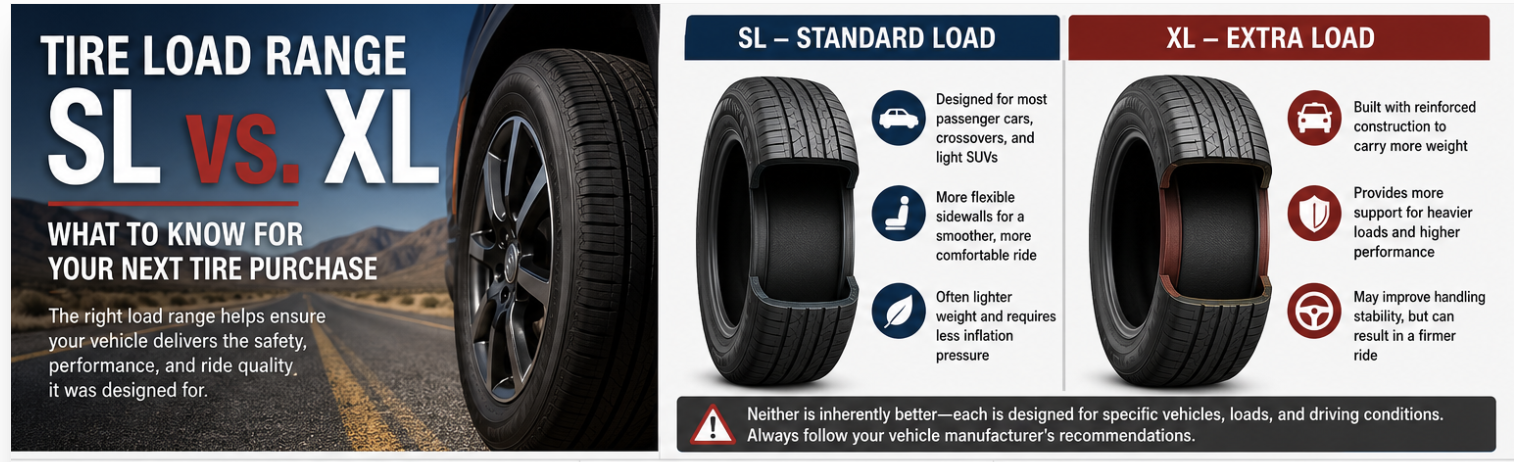
A Standard Load tire is designed to support the loads commonly placed on passenger cars, crossovers, and some lighter SUVs. It typically reaches its standardized maximum load capacity at a lower reference inflation pressure than an XL tire.
An Extra Load tire, sometimes identified as a reinforced tire, is built to support additional load when inflated to the appropriate pressure. It usually has a stronger internal structure and is designed to operate at higher inflation pressures than a comparable Standard Load tire.
That does not mean every XL tire carries more weight than every SL tire. Actual carrying capacity is determined by several factors, including:
- Tire size
- Load index
- Inflation pressure
- Vehicle weight distribution
- Tire construction
- The applicable tire load-and-inflation standards
The load index is especially important. It is the numerical code immediately following the tire size and indicates the maximum load the tire can support under specified conditions.
For example, two tires may both be marked 225/55R17, but one may have a load index of 97 while another has a load index of 101 XL. The second tire is designed to support a greater maximum load, but that capacity depends on proper inflation.
When comparing tires, look at the complete service description—not merely whether the sidewall says SL or XL.
SL vs. XL Tires at a Glance
Standard Load tires are generally designed around the needs of ordinary passenger vehicles. They often offer a favorable balance of comfort, fuel economy, road isolation, and predictable handling.
Extra Load tires are designed for vehicles or driving situations that place greater demands on the tire. Depending on the tire model, they may provide additional load capacity, more sidewall support, and greater stability when the vehicle is heavily loaded.
The practical differences often include:
Standard Load tires
- Appropriate for many passenger cars and crossovers
- Frequently provide a softer, more compliant ride
- May weigh less than a reinforced equivalent
- Generally require less inflation pressure to support their rated load
- Often cost less than a comparable XL version
Extra Load tires
- May provide a higher load index in the same tire size
- Are designed to support additional load at higher pressures
- May improve stability on heavier vehicles
- Can provide more responsive steering in certain applications
- May feel firmer over potholes, expansion joints, and rough pavement
These are general tendencies, not universal rules. Tire compound, tread design, sidewall construction, wheel diameter, aspect ratio, and suspension tuning can affect ride quality just as much as the SL or XL designation.
Does an XL Tire Have a Stronger Sidewall?
XL tires are commonly described as having reinforced sidewalls, but the reinforcement may involve more than simply making the visible sidewall thicker.
Manufacturers may alter the casing, bead area, cord materials, belt package, or other internal components so the tire can safely contain higher pressure and carry additional weight. The exact design varies by manufacturer and tire model.
That stronger construction can produce several practical benefits, including improved support under load and reduced sidewall deflection. It may also make steering feel more direct.
However, a stronger passenger-car XL tire should not be confused with an LT tire designed for light trucks.
An XL passenger tire and an LT tire are not interchangeable categories. LT tires may use load ranges such as C, D, or E and are designed according to different load-and-inflation requirements. A driver should not assume an XL tire provides the same capabilities as an LT Load Range E tire simply because both are built for heavier service.
This distinction is particularly important for pickup trucks used for towing, commercial work, or heavy hauling.
Understanding the Inflation Difference Between SL and XL Tires
Inflation pressure is one of the most misunderstood parts of the SL-versus-XL comparison. An XL tire can carry more weight than a comparable SL tire, but its reinforced construction alone does not create all of that additional capacity. The tire must also be inflated to the pressure required for the load it is carrying.
Think of inflation pressure as part of the tire’s support system. The tire’s internal construction contains the air, but the pressurized air supports much of the vehicle’s weight. As the required load increases, additional pressure may be necessary to limit excessive sidewall flex, control heat buildup, and keep the tire operating within its engineered capacity.
An XL tire is designed to tolerate higher operating pressures than a comparable Standard Load tire. This allows it to continue gaining load capacity after the Standard Load version has reached its standardized maximum. Michelin describes XL tires as reinforced tires capable of carrying higher loads than standard tires of the same size when inflated to higher pressures.
However, this does not mean an XL tire must always be inflated more simply because “XL” appears on its sidewall.
An XL Tire Does Not Automatically Need Maximum Pressure
Suppose a vehicle originally uses SL tires and its door placard recommends 33 PSI. If properly selected XL replacements provide the required load capacity at 33 PSI, the vehicle may still use the placard pressure. The XL tire does not need to be inflated to 41, 44, 50, or another higher number merely because it is capable of handling additional pressure.
The higher pressure becomes relevant when the tire must support the additional load represented by its higher load index. In other words, an XL tire’s extra capacity is available only at the corresponding pressure shown in the applicable load-and-inflation table.
That distinction is important:
- At ordinary pressures, an SL and XL tire of the same size may support similar loads.
- The XL tire can support additional weight when pressure is increased within its approved range.
- The exact relationship depends on the tire size, load index and applicable load table.
Continental notes that a reinforced tire operating at its full rated load may require approximately 0.4 bar—about 6 PSI—more pressure than a comparable standard tire at its full rated load. That does not mean drivers should routinely add 6 PSI to the pressure printed on the vehicle placard. It illustrates why XL tires can reach a higher maximum load capacity.
Use the Door-Placard Pressure, Not the Sidewall Maximum
For normal driving with the vehicle’s original tire specification, the starting point should be the cold inflation pressure listed on the vehicle information placard, usually located inside the driver’s door opening.
The pressure molded onto the tire sidewall is different. It identifies the tire’s maximum cold inflation pressure or the pressure associated with its maximum rated load. It is not necessarily the recommended everyday pressure for the vehicle.
Michelin specifically advises that the “MAX LOAD” and “MAX PRESS” sidewall markings are tire limits rather than the vehicle’s recommended operating pressure. Drivers should use the owner’s manual or tire placard to find the pressure specified by the vehicle manufacturer.
Inflating every tire to its sidewall maximum can produce:
- A harsher ride
- Greater impact sensitivity
- Changes in steering response
- Irregular tread wear
- Reduced compliance over rough pavement
The vehicle manufacturer selects its recommended pressure by considering axle loads, tire capacity, braking, handling, ride quality and other aspects of the complete vehicle.
Why Underinflation Is Especially Problematic Under Load
When a tire is underinflated for the weight it is carrying, its sidewalls flex more than intended every time the tire rotates. That repeated flexing generates heat within the tire structure.
The problem becomes more serious when underinflation is combined with:
- Heavy cargo
- Towing
- Sustained highway speeds
- High outdoor temperatures
- Long-distance driving
An XL tire that is carrying an XL-level load without enough pressure may not provide the capacity shown by its load index. The tire may look only slightly low while still operating under excessive stress.
This is especially relevant in West Texas, where summer heat, long highway drives, work vehicles, pickups and heavily loaded SUVs can place substantial thermal and mechanical demands on tires.
Check Pressure When the Tires Are Cold
Tire pressure should be checked when the tires are cold—ideally before driving or after the vehicle has been parked long enough for the tires to return close to ambient temperature.
Pressure naturally rises as a tire warms during use. Drivers should not normally release air from a warm tire simply because the reading is higher than the cold-pressure specification. Doing so can leave the tire underinflated after it cools.
Pressure should also be checked more frequently when:
- Temperatures change substantially
- The vehicle is carrying an unusual load
- A trailer will be attached
- A TPMS warning appears
- One tire repeatedly loses pressure
- The vehicle has recently received new tires
What Happens When Switching Between SL and XL?
When replacing an SL tire with an XL tire in the same size, the installer should confirm that the new tire meets the vehicle’s load-index and speed-rating requirements. For an approved replacement that maintains the original specifications, the vehicle placard remains the normal pressure reference.
The situation may require more detailed calculation when:
- The tire size is being changed
- The new tire uses a different load index
- The vehicle carries commercial equipment
- The vehicle is modified
- The vehicle regularly operates near its maximum axle weight
- The replacement differs substantially from the original specification
In those situations, a qualified tire professional may need to compare the original and replacement tires using the appropriate load-and-inflation tables. Pressure should not be selected by guessing or by automatically using the highest number on the sidewall.
The most important point is simple: XL tells you what the tire is capable of supporting, but correct inflation determines how much of that capability is actually available.
How Do SL and XL Tires Affect Ride Quality?
Ride quality is one of the most noticeable differences drivers may experience after changing tire specifications.
Standard Load tires often provide a smoother ride because the tire casing can flex more readily as it travels over bumps and uneven pavement. This flexibility helps isolate the cabin from minor road imperfections.
Extra Load tires may feel firmer because their construction is designed to limit excessive deformation under heavier loads and higher inflation pressures. That added support may improve stability and steering response, but it can also transmit more road texture into the vehicle.
The difference is often more noticeable when:
- The vehicle has large-diameter wheels
- The tires have short sidewalls
- The suspension is already firm
- The tires are inflated above the vehicle’s recommended pressure
- The vehicle is driven primarily without passengers or cargo
- Roads are rough, broken, or heavily patched
An XL tire does not automatically create an uncomfortable ride. Many vehicles are engineered around XL tires from the factory, and their suspensions are tuned accordingly. Problems are more likely when an unnecessarily stiff tire is installed on a vehicle that was designed for a softer Standard Load tire—or when the replacement tires are overinflated.
When Are XL Tires Required or Recommended?
Many modern vehicles are equipped with XL tires as original equipment. Manufacturers may specify them when a vehicle’s weight, performance, suspension geometry, or expected use requires additional tire capacity.
XL tires are commonly found on:
- Larger crossovers and SUVs
- Performance cars
- Sport sedans
- Electric vehicles
- Vehicles with large wheels and low-profile tires
- Vehicles that regularly carry passengers or cargo
- Some vehicles approved for towing
- Certain light-duty pickup trucks
Electric vehicles frequently use XL tires because battery packs add substantial weight. Electric motors can also deliver immediate torque, placing additional stress on the tread and tire structure. Some EV-specific tires combine reinforced construction with specialized tread compounds, noise-reduction features, and low-rolling-resistance designs.
Performance vehicles may use XL tires for a different reason. Even when the vehicle is not carrying cargo, the reinforced structure may help maintain stability during acceleration, cornering, and braking.
For SUVs and crossovers, the added capacity may be necessary to support the vehicle’s curb weight, passengers, cargo, and optional equipment.
If your vehicle came with XL tires from the factory, replacing them with lower-capacity SL tires may not provide the load capacity or handling characteristics the manufacturer intended.
Can You Replace SL Tires With XL Tires?
It is often possible to replace an SL tire with an XL tire in the same size, provided the replacement meets all of the vehicle’s requirements.
The replacement tire should have:
- The correct tire size
- A load index that meets or exceeds the original requirement
- An appropriate speed rating
- Adequate clearance
- Compatibility with the wheel
- Proper pressure for the vehicle and load
- Construction suitable for the vehicle’s intended use
Potential advantages of switching from SL to XL may include greater load capacity, additional support when carrying cargo, improved stability, or access to a tire model that is only manufactured in an XL version.
Potential disadvantages may include a firmer ride, higher tire weight, increased cost, and changes in steering feel or rolling resistance.
Installing XL tires does not increase the vehicle’s legal payload, Gross Vehicle Weight Rating, Gross Axle Weight Rating, or towing capacity. Those limits are established by the vehicle manufacturer and are based on the entire vehicle—not just the tires.
A higher-capacity tire cannot make an overloaded suspension, axle, wheel, or braking system safe.
Can You Replace XL Tires With SL Tires?
Replacing a factory-specified XL tire with an SL tire requires greater caution.
Even when the tire size printed on the sidewall is identical, an SL version may have a lower load index or may not provide the same load capacity at the vehicle’s recommended pressure. It could also alter steering response and stability.
An SL replacement should not be installed unless it meets or exceeds the original tire’s required load index, speed rating, and other vehicle specifications.
This is especially important for:
- Electric vehicles
- Heavier luxury vehicles
- Performance models
- Fully loaded SUVs
- Vehicles used for towing
- Vehicles carrying tools or commercial equipment
When the vehicle manufacturer specifies XL tires, continuing to use the correct XL specification is generally the safest choice.
Why Load Index Matters More Than the Letters Alone
One of the most common tire-buying mistakes is focusing on SL versus XL while overlooking the load index.
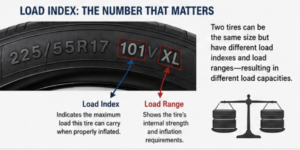
The load index is the number located after the tire size. A typical service description might look like:
225/55R17 101V XL
In this example:
- 225 is the tire width in millimeters.
- 55 is the aspect ratio.
- R indicates radial construction.
- 17 is the wheel diameter.
- 101 is the load index.
- V is the speed rating.
- XL indicates Extra Load construction.
The load index tells you how much weight the tire is rated to support according to standardized tables. Because each tire carries only part of the vehicle’s total weight, all four tires must provide sufficient capacity for the vehicle, passengers, cargo, and normal weight transfer during driving.
The number required for your vehicle can usually be found on the tire information placard located inside the driver’s door opening or in the owner’s manual.
When purchasing replacement tires, the load index should generally meet or exceed the original equipment specification unless the vehicle manufacturer provides different guidance.
Why Correct Tire Pressure Is Essential
XL tires achieve their additional load capacity through a combination of reinforced construction and appropriate inflation pressure.
However, installing an XL tire does not mean you should inflate it to the maximum pressure printed on its sidewall.
The sidewall number is generally the maximum cold pressure associated with the tire’s rated limits—not necessarily the correct operating pressure for your vehicle.
For normal driving, begin with the cold-tire pressure listed on the vehicle’s tire placard. This placard is commonly located:
- On the driver’s door jamb
- On the door pillar
- Inside the fuel door on some vehicles
- In the owner’s manual
Pressure should be checked when the tires are cold, meaning the vehicle has been parked long enough for the tires to return close to ambient temperature or has only been driven a short distance at low speed.
Incorrect pressure can cause:
- Uneven tread wear
- Reduced steering control
- Excess heat buildup
- Longer braking distances
- Reduced fuel economy
- Increased risk of tire damage
- Premature tire replacement
- Tire-pressure monitoring system warnings
Underinflation is particularly dangerous when a vehicle is carrying heavy cargo or traveling at highway speeds. An underinflated tire flexes excessively, generating heat inside the tire structure. Over time, that heat can contribute to internal damage or tire failure.
Overinflation is not the solution. Excessive pressure may reduce ride comfort, decrease the tire’s ability to absorb impacts, and produce irregular tread wear.
For unusual loading or towing situations, consult the vehicle manufacturer’s instructions or a qualified tire professional rather than guessing at the correct pressure.
Do XL Tires Last Longer Than SL Tires?
An XL tire is not automatically a longer-lasting tire.
Tread life depends on the tire’s compound, tread design, alignment, inflation pressure, rotation schedule, road conditions, driving style, vehicle weight, and maintenance history.
An XL tire may be more durable in an application that consistently places high loads on the tire. If an SL tire is operating near or beyond its intended capacity, excessive heat and casing flex can accelerate wear. In that situation, the properly rated XL tire may perform better over time.
On a lighter vehicle that does not require additional capacity, however, the heavier construction of an XL tire does not guarantee additional mileage. A tire’s treadwear warranty and expected service life should be evaluated separately from its load designation.
To get the best life from either type of tire:
- Maintain the vehicle’s recommended cold pressure
- Rotate the tires at the recommended interval
- Check wheel alignment when uneven wear appears
- Inspect suspension and steering components
- Avoid exceeding vehicle load limits
- Replace damaged or severely aged tires
- Choose a tire suited to local road and weather conditions
West Texas Heat Makes Correct Load Capacity Even More Important
Drivers in Abilene, San Angelo, Eastland, and surrounding areas regularly encounter high pavement temperatures, long highway drives, heavy pickup and SUV use, and vehicles carrying work or recreational equipment.
Heat is a major source of tire stress. As a tire rolls, its sidewall and internal structure repeatedly flex. That movement generates heat. Heavy loading, low inflation pressure, high speeds, and extreme outdoor temperatures can increase that heat further.
A properly rated and properly inflated tire is better equipped to operate under those conditions.
Drivers should check tire pressure regularly during West Texas summers, but pressure should not be released simply because it rises after driving. Tire pressures naturally increase as the tires warm. The vehicle’s recommended pressure is normally measured when the tires are cold.
Frequent pressure loss, sidewall cracking, bulges, vibration, or unusual tread wear should be inspected promptly.
How Tires Affect Handling, Braking, and Alignment
Tires are part of the vehicle’s complete steering, suspension, and braking system. Their construction influences how the vehicle responds to driver inputs and road conditions.
Changing tire type can affect:
- Steering response
- Cornering stability
- Braking feel
- Road noise
- Ride comfort
- Traction
- Fuel efficiency
- Suspension response
Even the correct tire will wear prematurely if the vehicle has an alignment or suspension problem.
Common signs of an alignment issue include:
- Uneven wear across the tread
- Rapid wear on one shoulder
- A steering wheel that is off-center
- Vehicle pulling or drifting
- Feathered tread edges
- New tires becoming noisy unusually quickly
A wheel alignment inspection is especially worthwhile when replacing tires that have developed irregular wear. Installing new tires without correcting the underlying alignment or suspension problem can shorten the life of the replacement set.
Which Tire Is Right for Your Vehicle?
Neither Standard Load nor Extra Load is universally better.
An SL tire may be the appropriate choice when the vehicle was designed for Standard Load tires, is driven under normal passenger-car conditions, and does not require additional load capacity.
An XL tire may be appropriate or required when the vehicle is heavier, was factory-equipped with XL tires, regularly carries substantial cargo, or requires a higher load index.
Before making a decision, check:
- The tire information placard inside the driver’s door
- The original tire size
- The required load index
- The required speed rating
- The vehicle’s normal cargo and passenger load
- Whether the vehicle is used for towing
- The manufacturer’s recommendations
- The condition of the wheels, suspension, and alignment
Tire selection should be based on the vehicle’s actual specifications—not the assumption that a higher designation is always better.
Frequently Asked Questions About SL and XL Tires
Are XL tires better than SL tires?
XL tires are not inherently better. They are designed to support additional load at the appropriate inflation pressure. An SL tire may provide the correct capacity, comfort, and performance for a vehicle that does not require an Extra Load tire.
Do XL tires require more air pressure?
XL tires are capable of operating at higher pressures to achieve their additional load capacity. For everyday driving, however, use the vehicle manufacturer’s recommended cold pressure unless different instructions apply to a specific loading situation.
Will XL tires make my ride rougher?
They may produce a firmer ride, particularly on a lighter vehicle or when paired with large wheels and low-profile tires. The actual difference depends on the tire model, pressure, vehicle suspension, and road surface.
Can XL tires improve handling?
Their reinforced construction may improve steering response and stability in some vehicles. However, handling also depends on tread design, rubber compound, tire width, wheel size, alignment, suspension condition, and inflation pressure.
Are XL tires good for towing?
An XL tire may be appropriate for certain towing applications, but the complete tire load index and the vehicle manufacturer’s towing requirements must be considered. Installing XL tires does not increase the vehicle’s factory towing or payload rating.
Are XL tires the same as Load Range E tires?
No. XL normally refers to an Extra Load passenger tire. Load Range E is commonly associated with certain LT tires and follows different load-and-inflation standards. They should not be treated as equivalent classifications.
Do electric vehicles need XL tires?
Many electric vehicles require XL tires because of their additional battery weight and high torque output. The replacement tire should meet the vehicle manufacturer’s required size, load index, speed rating, and any EV-specific recommendations.
Can I mix SL and XL tires?
Mixing different tire specifications can affect handling and stability. The best practice is generally to use matching tires with the correct size, construction, load index, speed rating, and tread characteristics on all four wheel positions, subject to the vehicle manufacturer’s recommendations.
Get Professional Tire Advice at Tom’s Tire Pros
Since 1976, Tom’s Tire Pros has helped drivers in Abilene, San Angelo, Eastland, and surrounding West Texas communities choose tires that fit their vehicles, driving conditions, and long-term needs.
Our team can help you compare tire sizes, load indexes, SL and XL specifications, tread designs, warranties, and performance characteristics. We can also inspect related systems that affect tire safety and service life, including wheel alignment, steering components, suspension parts, and the tire-pressure monitoring system.
Whether you drive a passenger car, SUV, electric vehicle, pickup truck, work vehicle, or family crossover, the right tire should provide more than adequate tread. It should support the vehicle’s weight, maintain predictable handling, and perform safely in the conditions you encounter every day.
Visit Tom’s Tire Pros for new tires, wheel alignment service, TPMS diagnosis, tire maintenance, and complete auto repair in Abilene, San Angelo, and Eastland.